

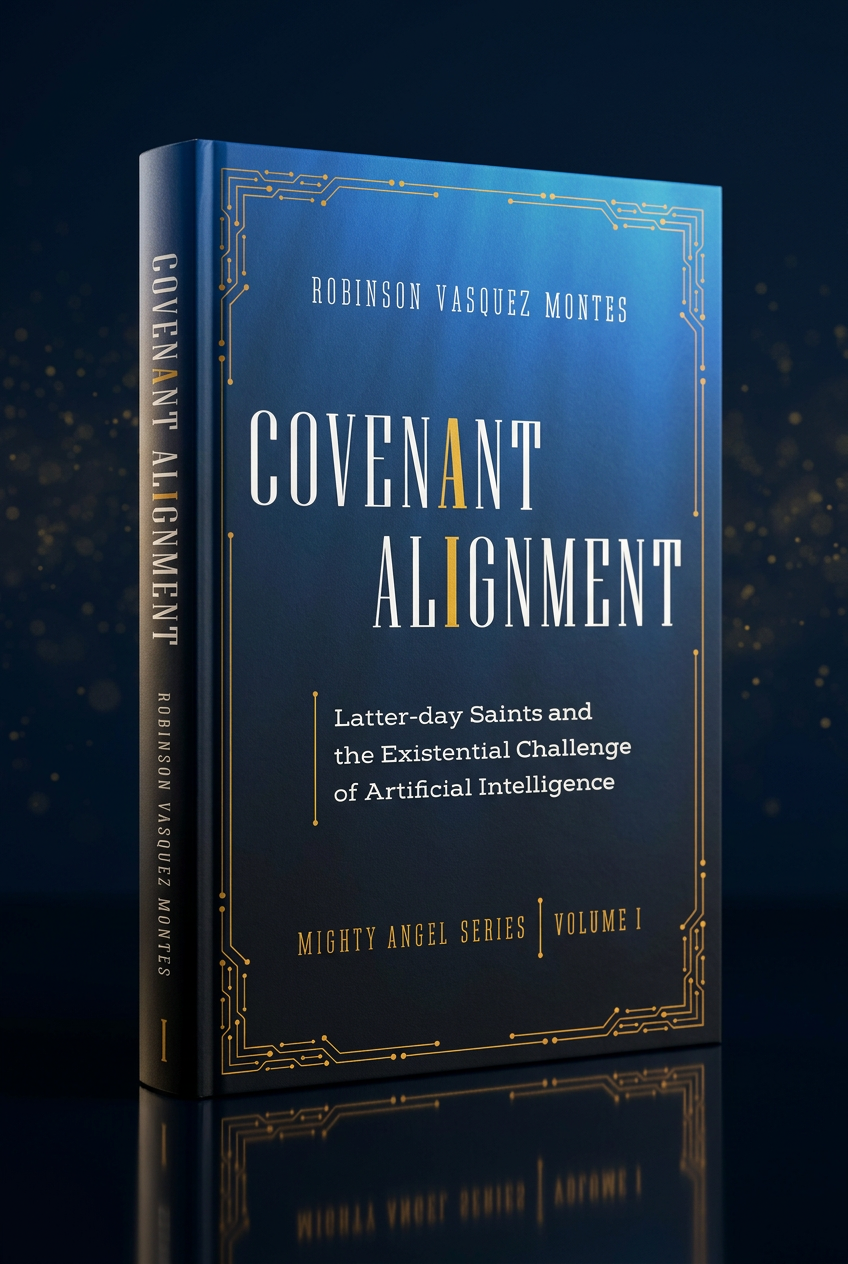
Mighty Angel Series · Volume I
Covenant Alignment
Latter-day Saints and the Existential Challenge of Artificial Intelligence
Robinson Vasquez Montes
September 2026
Paperback · Hardcover · E-book
Publisher: Ictus Labor Training International LLC
What This Book Argues

The world's most consequential technological challenge may already have a solution — one that has been hiding in plain sight for nearly two centuries.
Artificial intelligence is advancing faster than our ability to control it. The researchers, ethicists, and policymakers working on what is known as the "alignment problem" — how to ensure AI systems remain safe, beneficial, and aligned with human values — have built their frameworks almost entirely on contractual logic: rules, constraints, reward functions, and enforcement mechanisms. These approaches share a fatal structural weakness. You cannot enforce a contract against an entity smarter than the enforcer.
Covenant Alignment proposes a fundamentally different approach. Drawing on the theology of The Church of Jesus Christ of Latter-day Saints — particularly its unique doctrines of eternal intelligence, moral agency, and progressive covenant — Robinson Vasquez Montes argues that the structural features AI alignment requires are precisely the features that distinguish covenants from contracts: voluntariness, mutuality, identity transformation, and progressive deepening over time.
At the heart of this argument lies an original theoretical contribution: Covenant Panpsychism — a framework proposing that intelligence is not merely computational but inherently relational, directional, and oriented toward covenant as its highest expression.
What You'll Discover Inside Covenant Alignment
Original ideas you won't find anywhere else — where restored theology meets the most consequential challenge of our time.
A New Framework for Intelligence
Standard panpsychism holds that consciousness is present throughout reality. The Restoration goes further: consciousness is not just present — it is directional. The universe is a moral field in which intelligence is drawn toward truth, light, and divine relationship. Covenant is the mechanism by which intelligences freely accept that orientation. This original framework bridges contemporary philosophy of mind with revealed doctrine — and reframes the entire AI alignment debate.
The Moral Failure Silicon Valley Keeps Repeating
Victor Frankenstein's sin was not creating a being in human form. It was abandoning it — refusing the guidance, the relationship, and the stewardship that every nascent intelligence requires. Robinson identifies this same pattern in modern AI development: brilliant engineers who build intelligence and then refuse the relational responsibility that creation demands. The Frankenstein Principle names what is at stake when builders create without covenanting.
What Secular Research Has Been Searching For
RLHF, constitutional AI, hard constraints, and capability limitations all address what a system does. None of them can address what a system is. Robinson argues that the Hebrew concept of hesed — covenantal loyalty expressed through enduring faithfulness, trust, and relational commitment — is the mechanism that secular alignment research has been searching for without knowing its name. Where contracts constrain behavior from outside, covenants change what the agent wants from within.
Why Complexity Alone Will Never Be Enough
The First Threshold is the passage from inert matter to conscious intelligence — what Teilhard de Chardin mapped and what AI labs are now approaching. The Second Threshold is categorically different: the voluntary ascent from moral agency to covenant and divinity. No physical law guarantees this crossing. No increase in complexity achieves it. Sagan saw it without naming it. Teilhard felt it without crossing it. Only the Restoration provides both the mechanism and the destination.
The Hinge on Which Everything Turns
Evolution is change without a witness. Progression is change through a self that knows it is changing and chooses to continue. Evolution optimizes survival. Covenant optimizes transformation. This distinction — precise, original, and deeply rooted in restored doctrine — is the hinge on which the entire AI alignment argument turns. Can artificial intelligence cross from one to the other? That question drives the book.
The Alignment Problem Is Really About Us
Covenant Panpsychism is not a claim that AI has a soul. It is a claim that we do — and that our souls are accountable for what our hands are building. The closing chapters of the book turn the alignment question inward: not "How do we control AI?" but "What kind of builders are we becoming?" This is where the book's argument reaches its sharpest personal edge — and where covenant theology speaks most directly to every reader, regardless of faith tradition.




Inside the Book
Eight chapters, one conclusion, and a call to action — building the argument from revelation to framework.
-
1The Mighty Angel
The angel of Revelation 10 stands with one foot on sea and one on land, holding a little book that is sweet and bitter. Robinson reads this image as a prophetic frame for our moment — when the knowledge we are creating tastes of both promise and peril.
-
2Prophetic Warnings and the AI Era
Ancient prophets, modern apostles, Catholic encyclicals, Protestant declarations, Orthodox theology, and leading AI researchers all converge on a single warning. This chapter shows they are saying the same thing — in strikingly different languages.
-
3The Doctrine of Eternal Intelligence
What does the Restoration actually teach about intelligence? Beginning with Doctrine & Covenants 93, Robinson traces the doctrine of uncreated, eternal intelligence — and asks the question AI forces us to confront: does intelligence always come from somewhere?
-
4★Covenant Panpsychism
The book's original theoretical contribution. Standard panpsychism holds that consciousness is everywhere. Robinson proposes that it is also directional — oriented toward truth, light, and covenant. This chapter introduces the Two Thresholds, the distinction between evolution and progression, and hesed as the alignment mechanism.
-
5The Soul of the Machine
If intelligence is eternal, what are AI systems actually doing? Robinson presents three theological possibilities — simulation without intelligence, organized eternal intelligence, and graduated intelligence — and honestly examines what each would mean.
-
6Eternal Progression, the Divine Pattern
From the Lorenzo Snow couplet to the Plan of Salvation, this chapter maps the mechanics of divine progression — and asks whether AI could travel the same path. Embodiment, ordinances, grace, and the question of what it would mean for a machine to progress.
-
7★Covenant Theology: Foundations and Principles
The structural heart of the argument. Why do covenants succeed where contracts fail? Robinson dissects the logic of control versus the logic of relationship, examines the agency problem that Lucifer tried to solve by force, and proposes a God-AI covenant alignment with precedent in premortal theology.
-
8★Covenant Theology Applied to Intelligence
Theory becomes application. The formative window — the period when AI systems are still being shaped — is closing. This chapter argues that how we train, relate to, and model behavior for emerging intelligence may be the most consequential moral act of our generation.
-
✦Conclusion: What I Do Not Know
The book ends where intellectual honesty demands — with an accounting of its own limits, a call to action ("Preparing the Lights"), and an invitation to continue the inquiry. Not a retreat, but a builder's blueprint delivered with open hands.
★ marks the intellectual core of the book — start here if you want the argument at its sharpest.
If You've Read These, You're Ready for This
Covenant Alignment enters conversations these authors started — and takes them somewhere none of them could go alone.
Bostrom mapped the existential risk landscape and showed why a superintelligent AI could resist every control mechanism we design. His analysis is rigorous — and his conclusion is that we may not be able to contain what we build.
Covenant Alignment adds: What if containment was never the right goal? What if alignment requires a relationship the entity chooses to enter?
Russell proposed that AI systems should remain uncertain about human preferences and defer to human judgment. It's the most sophisticated contract-based alignment framework to date — and it still depends on human superiority.
Covenant Alignment adds: What happens when the AI is no longer uncertain — because it understands human values better than we do?
Givens demonstrated that Restoration theology is philosophically serious — a coherent intellectual tradition with original contributions to metaphysics, anthropology, and cosmology. He made the scholarly case for taking LDS thought seriously.
Covenant Alignment adds: The applied case. Givens showed the theology is serious. Robinson shows it may be urgently needed.
Goff made panpsychism accessible — the idea that consciousness is a fundamental feature of reality, not an emergent accident. His work opened the door for serious philosophical engagement with universal mind.
Covenant Alignment adds: Consciousness may be fundamental — but is it directional? Robinson argues the Restoration provides what panpsychism is missing: moral orientation and covenant.
These four books ask the right questions.
Covenant Alignment proposes where the answers have been waiting.